
The Platform
The pipeline is the platform
Real business work runs in passes. The associate drafting a contract reads it once for structure, again for the clauses, again for the issues, again for the counter-language. The analyst building a dossier finds the sources, reads them, triangulates the conflicts, and writes the narrative. The compliance lead running a gap analysis reads the policy, maps it to the controls, finds what is missing, and writes the remediation plan. Nobody who does serious work for a living asks for the answer once and ships what comes back.
BWI® is built the same way. Every operation on the platform routes through a multi-pass pipeline with an input schema, an output schema, a writeable intermediate state, and a row in the audit log for every pass. Foundry generates a document in five passes (structure, generation, cohesion, compliance, summary). Forge runs legal contract review in five passes plus a separate revision-comparison pass, and builds research dossiers in six. Axis runs compliance gap analysis in four. Concierge grounds an agent's answer through a three-tier prompt resolution. One architectural pattern, applied across domains, producing structured, auditable, repeatable output every time.
Some passes generate, some verify, some score. Each has its own tunable prompt and its own assigned provider, picked for the task. The verification passes are how the platform refuses to ship a false claim: it checks its own work before it produces an output the customer is responsible for.
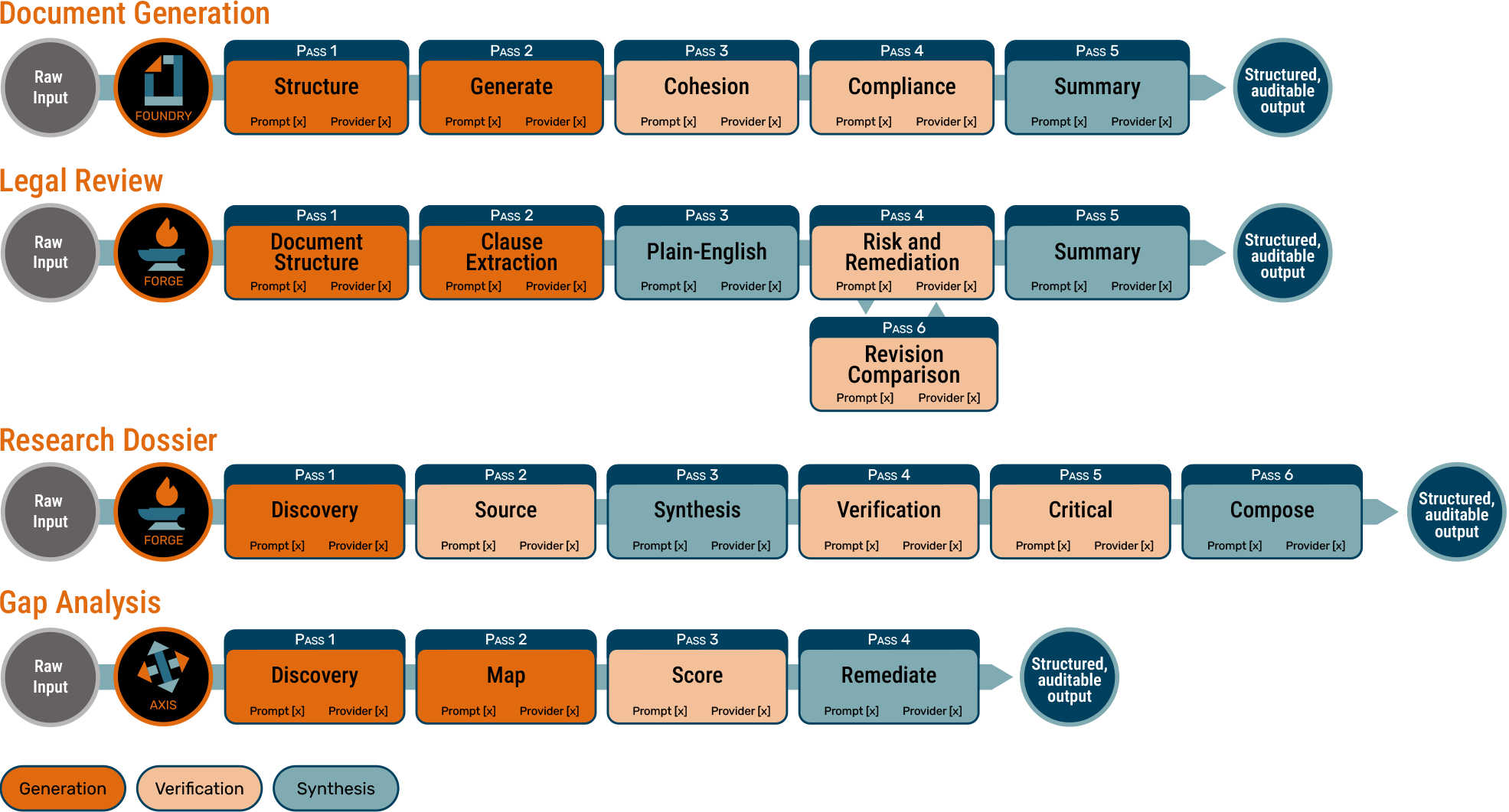
Same pattern, different domain.
Every pass has its own prompt and its own provider, tuned for the task. Verification passes are the platform refusing to ship false claims.
What it means to engineer intelligence
The pipeline is the visible shape. The intelligence layer underneath is the engineering that makes the pipeline work.
Every model call on the platform routes through the Intelligence Queue: centralized, cost-tracked, rate-limited, audit-logged, with built-in failover. The queue is the only path a model call takes, and every call captures provider, model, prompt template, response, cost, user, and isolation boundary. The compliance posture and the engineering posture are the same posture.
The Provider Manager is capability-based, not vendor-locked. Every call declares the capability it needs, and the manager resolves the active provider from the database. Multiple providers can satisfy one capability. When a provider degrades or a better one ships, BWI rotates without customer involvement. The capability is the contract; the brand behind it is replaceable.
The Prompt Manager is the canonical source of truth for which provider runs which operation. Every prompt is a versioned database row, edited in the admin UI by a customer-authorized administrator and audited like any other change. Not an environment variable. Not a redeploy. The compliance lead can read the prompt history from the admin UI without filing a ticket.
The result is intelligence engineered for repeatability: the same prompt produces the same result shape tomorrow as it does today. Output is not a hope. It is a design. This is what Intelligence, not AI, means in practice: the model is one governed component inside an engineered system, never the system itself.
No inside seams.
BWI is a single platform with many products built on it. The shared kernel and the products are one codebase, one schema partitioned for clarity and never reconciled, one set of conventions. Every product automatically inherits the identity, the intelligence layer, the relationship graph, the brand kit registry, the audit log, the isolation model, and the action bus from the core, because the core ships them once.
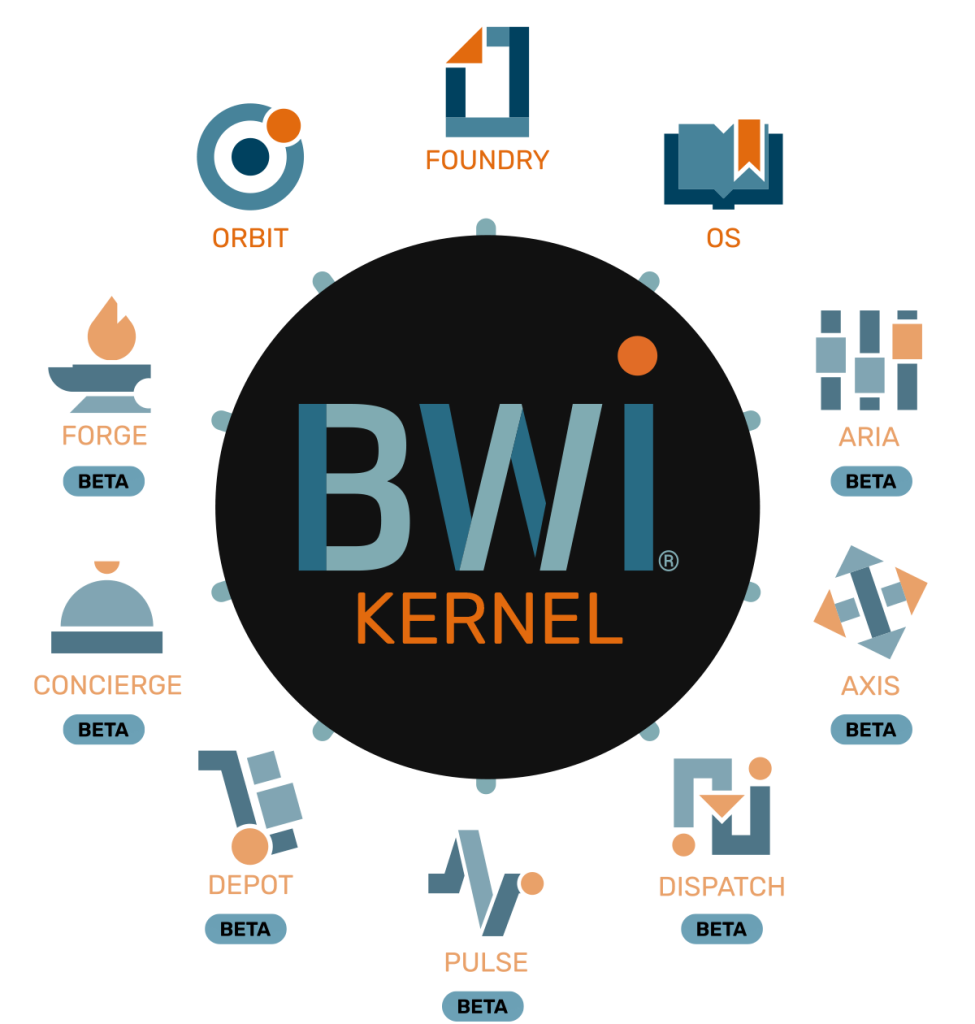
Products share that one schema and call each other directly, without webhooks, integration platforms, or middleware. The customer's contact in Orbit is the same contact that a Foundry document binds to, the same contact that a Concierge agent recognizes, and the same record that an Axis assessment references. Every cross-product call writes to the same audit trail every model call writes to. The connective tissue between products is the core itself.
This is a platform with no inside seams. Every product does its specific job; every product reads from and writes to the same data. The customer's brand kit is the customer's brand kit everywhere. The customer's audit trail is one audit trail. The customer's isolation boundary is one isolation boundary. Not a federation of tools the customer paid to connect. One thing, with many products on it.
The platform that does not betray you
Every customer instance is its own deployment, its own database, its own encryption keys, its own isolation boundary. Single-tenancy is the default. The isolation model enforces per-customer or per-entity isolation at the layer beneath the product code, so a developer cannot accidentally bypass the rule: the rule lives below the code path the developer writes.
BWI was architected to ISO 42001 from day one. Full prompt control through the Prompt Manager. Full audit of every intelligence call through the Audit Log. Encryption at rest. Formal SOC 2 Type 2 and ISO 42001 certification are targeted ahead of general availability. BWI inherits SOC 2 alignment from its parent, INT.
Your data is yours. Exportable any time, in usable formats, with nothing to negotiate. If you ever leave BWI, we hand back what is yours. A commitment, not a feature.
What this is not
BWI is not a transactional ecommerce platform, a manufacturing ERP, or a consumer marketing tool. It is not a vertical application for domains we do not model: banking with bespoke regulatory regimes, clinical healthcare workflows, government procurement. It is built for small businesses, so they can focus on what they do best. The shape of the platform reflects the shape of the work it does.
BWI is in limited release. We are onboarding a small cohort of operators ahead of general availability.